
Drinkability: High
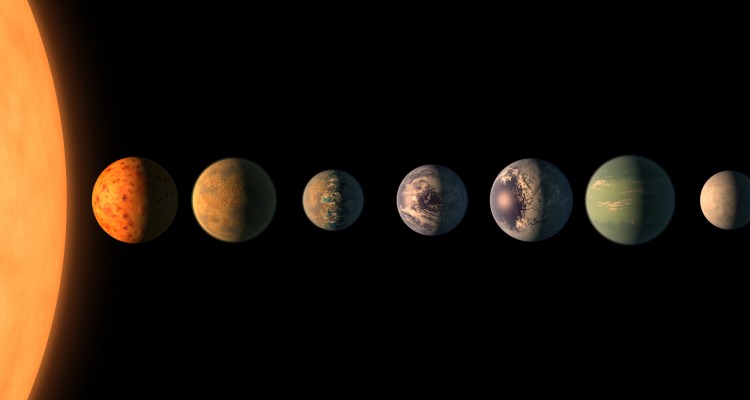
Or so we hope. Planets around other stars in our Milky Way are known as exoplanets and are as exciting and diverse as our fellow humans. From Jupiter-sized planets so close to their host star that their year lasts only one day to far-orbiting giant rocky planets several times the size of our Earth, astronomers tend to be interested in them all. But we’re on the hunt for water. And, in fact, so is the astronomical community.
The ideal planet, both scientifically and for the distant goal of future colonization, is somewhere in the sweet spot between ultra-close and super-distant from its host star. Not too cold. Not too hot. But just right. Just right for what? Hosting liquid water.
Enlarge

Graphic by: Ramses Mario Ramirez
This so-called Habitable or Goldilocks zone, named after the popular fable, is the range of distances from a star which a planet can be without all water either freezing or vaporizing. As we began to see in Mars’ case, there are several factors (atmosphere, stellar type, geothermal heating) which affect whether water can stay liquid. This means that the actual boundaries of the Goldilocks zone for a given star are very nebulous. Nevertheless, the idea of a habitable zone, gives us a good idea of where to look for liquid water on alien worlds.
Being one of the fewer than four dozen (of the more than 6000 detected) exoplanets observed in the habitable zone is no guarantee that the planet will have sufficient conditions for water. These planets range in nature from gas giants like our own Neptune to planets more than twice the size of Earth covered entirely in water to the rare nearly-Earth-sized planets.
Thus far, astronomers have observed water in the atmospheres of only a handful of planets in the Goldilocks zone. Mars is close enough that we can send satellites and rovers to investigate it directly; however, to detect water in anything outside of our solar system, we rely on observations of the object’s chemical spectrum. This goes for exoplanets, too. However, since the atmospheres of these planets stand between us and their surfaces, we can’t even tell for sure if there is liquid water on the surface. Therefore, until observational instrumentation and method improve, to predict whether these planets are likely to host liquid water, theorists have to rely on models of these planets and star systems.
I hope you filled up your water with the supply from that last planet because we are about to plunge even deeper into that great beyond. We now leave the safety of our own Milky Way to explore water in other galaxies.
Distance to next destination: 100 quintillion miles (24 million light years)
To stay hydrated, drink: 4.4 quintillion gallons (or, 100th of the water in Earth’s oceans)