
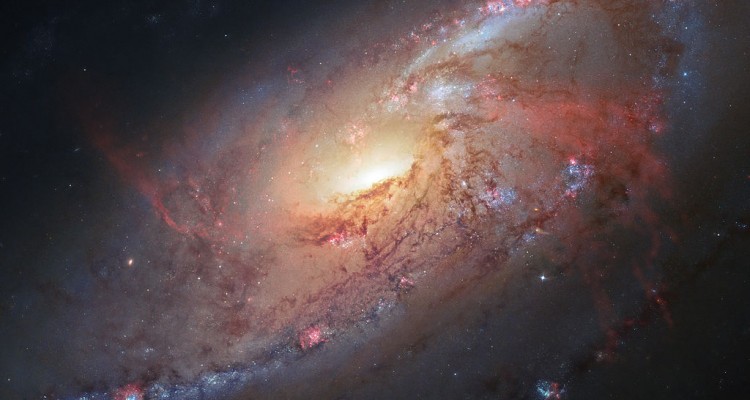
Drinkability: Low.
What is a maser? Well, it’s just like a laser, but with an “m”. Really, though. M.A.S.E.R. stands for Microwave Amplification by Stimulated Emission of Radiation. It functions exactly the same as a laser does, but just shines at a longer wavelength than the visible light of a laser.
The ingredients for any laser or maser are relatively simple: a heat source, a gas, a long path, and a cooling mechanism. As unbelievable as it may seem, there are naturally occurring masers in space.
These water masers appear around stars, in interstellar gas, and in the active nuclei of galaxies. The latter gives birth to an especially interesting form of maser. These so-called megamasers are powered by the active supermassive black hole (a million to a billion times the mass of our sun) in the center of a galaxy. The name “mega” comes from the fact that these masers are 1 million times brighter than any other type of maser and more than ten times brighter than our own sun.
Enlarge
Photo by: James M. Moran
In Messier 106, a relatively nearby galaxy 24 million light years from Earth, a maser was detected in the disk of material orbiting around and feeding the active supermassive black hole. The accretion disk – as the disk of material is known – is the perfect candidate for a water maser. Think back to that recipe for a maser: heat, gas, long path, and a cooling mechanism. In the accretion disk, the megamaser has the black hole as a heat source, water gas in the disk, a long path when the disk is viewed edge-on, and the flat geometry of the disk, which is optimal for cooling.
Discovered in 1999, the water megamaser in the accretion disk of Messier 106 facilitated what was then the most accurate measurement ever of a black hole’s mass. It also helped astronomers make extremely accurate measurements of the distance to the galaxy, which, in turn, was used to help measure the expansion rate of the universe. If those nuggets weren’t enough to consider this water maser a treasure trove of information, the maser also provided such detailed resolution of motion in the accretion disk, that observers were able to determine that the disk had a warp in it. Thanks to the water maser, astronomers made the huge leap from only suspecting that accretion disks were present around active supermassive black holes, to being able to tell a disk’s exact shape.
All things considered, this galaxy is actually relatively close to Earth. If we continue our journey outward, to a galaxy more than 100 times farther away, we can get a glimpse of the most distant water discovered in our universe.
Distance to next destination: 70 sextillion miles (12 billion light years)
To stay hydrated, drink: 2 sextillion gallons (or, the weight of Mars in water)